
Reframing Your Relationship to Conflict: Why Avoiding It Creates the Confrontation We Fear Most
March 2026
Hello Community—Happy Women’s History Month! This month always invites reflection on leadership, courage, and the ways women show up for one another in community.
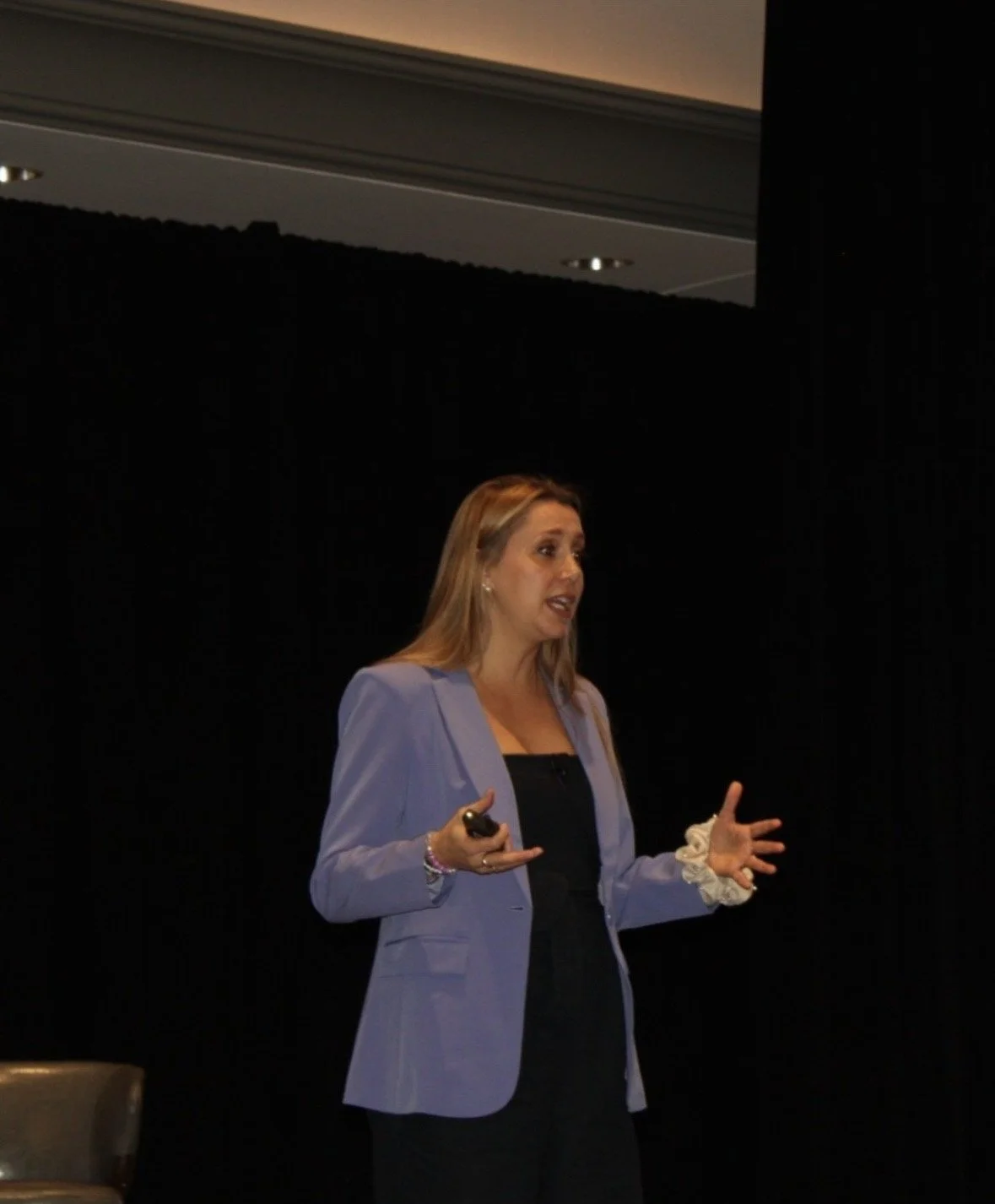
At the end of February, I had the privilege of giving a keynote at Sigma Kappa’s Summit for Collegiate Leadership in Chicago. Can I just say…what an awesome weekend and a wonderful community of women to hang out with!
I was asked to give one of my signature keynotes, Rewiring Stress: Turning Pressure into Purpose. While the keynote explored stress as a whole, the main focus wasn’t on the stress of exams or deadlines, but on the kind of stress that comes with leadership. The stress of being in relationship with other people.
Navigating different personalities. Holding responsibility for a group. Making decisions that won’t make everyone happy. And inevitably…conflict.
Reframing Your Relationship to Conflict:
Why Avoiding It Creates the Confrontation We Fear Most
At one point in the keynote, I asked a simple question:
“Raise your hand if you tend to avoid conflict.”
Almost every hand in the room went up. This happens every time I ask that question, whether I’m in a classroom, a boardroom, or a leadership retreat.
Here’s my hot take: Most people don’t actually fear conflict. They fear confrontation.
They imagine the worst-case scenario: heated arguments, damaged relationships, awkward tension, or the possibility of hurting someone. So they avoid the conversation altogether.
But here’s the paradox. When we avoid conflict, we often create the exact thing we’re trying to avoid.
Resentment builds. Misunderstandings grow. Trust erodes.
And eventually, the situation escalates into the very confrontation we were hoping to prevent, whether that confrontation happens externally with others or internally through ongoing stress and tension.
So what if conflict isn’t actually the problem?
One of the frameworks I often teach to normalize the importance of conflict comes from group development theory. While this model is often used to describe how teams develop, the concept applies to almost any relationship—friendships, colleagues, families, and partnerships.
When groups form, they typically move through several stages: forming, storming, norming, and performing.
The stage most teams try to skip? Storming.
Storming is the stage where differences surface. People challenge ideas, express frustrations, and test boundaries. In other words, it’s the stage where conflict shows up.
But storming isn’t a failure of the team or the relationship. It’s actually a necessary stage of development.
It’s through navigating conflict effectively that people clarify expectations, strengthen communication, and build trust.
When we avoid this stage, relationships often stay polite and “nice” on the surface but remain disconnected underneath.
When people move through it together, they build something much stronger and more resilient.
So if conflict is such an important part of healthy relationships, why does it feel so uncomfortable?
When conflict appears, our nervous system often interprets it as a threat. That’s when our stress responses kick in…Fight. Flight. Freeze. Fawn.
Some people escalate the conflict (fight).
Some avoid the conversation (flight).
Some shut down (freeze).
Some over-accommodate to keep the peace (fawn).
None of these responses make us bad leaders or bad people. They simply mean our system is trying to protect us.
The real work is learning to notice those reactions so we can choose something more intentional.
In my coaching and leadership work, I invite people to look at conflict through a different lens. Conflict isn’t you versus the other person. It’s both of you versus the problem. It’s an opportunity.
When approached with curiosity and respect, conflict can become a doorway to:
• deeper understanding
• clearer expectations
• stronger relationships
• better solutions
In fact, one of the fastest ways to build trust on a team is not avoiding conflict but working through something difficult together.
So how can you start to shift how you view conflict?
Pause before reacting.
Notice what your nervous system is doing before jumping into the conversation.
Lead with curiosity.
Ask questions instead of assuming intent.
Acknowledge and validate.
People become more open when they feel heard and understood.
Focus on the issue, not the person.
You are partners working toward a solution.
These skills are part of what I often call conflict intelligence: the ability to navigate differences in a way that strengthens relationships instead of damaging them.
I Invite You to Reflect:
*Where in my life am I currently avoiding a conversation?
*What am I afraid might happen if I address it?
*What might become possible if I approached it with curiosity instead of fear?
Conflict is inevitable anywhere humans gather. But confrontation doesn’t have to be.
When we learn to approach conflict with awareness, curiosity, and intention, it can become one of the most powerful tools we have for growth, trust, and connection.
Sometimes the conversations we most want to avoid are the ones that create the most clarity.
P.S. Learning how to navigate conflict with awareness and intention is one of the most powerful leadership skills we can develop. If you or your team want support strengthening communication, trust, and resilience, I’d be happy to connect. Send me a message!