
Pain, Discomfort, and Suffering: Learning to Listen Before It’s Too Late
April 2025
Hello, Community – As April winds down, we begin shifting from Stress Awareness Month into Mental Health Awareness Month.
It’s been a full year already, and if you're feeling overwhelmed, you're not alone—and it’s completely understandable.
Before we dive in, I want to pause and ask: How are you doing?
Take a deep inhale... and a long exhale... maybe one more.
And again, I’ll ask: How are you really feeling?
Today’s newsletter is inspired by an event that happened at the start of this month.
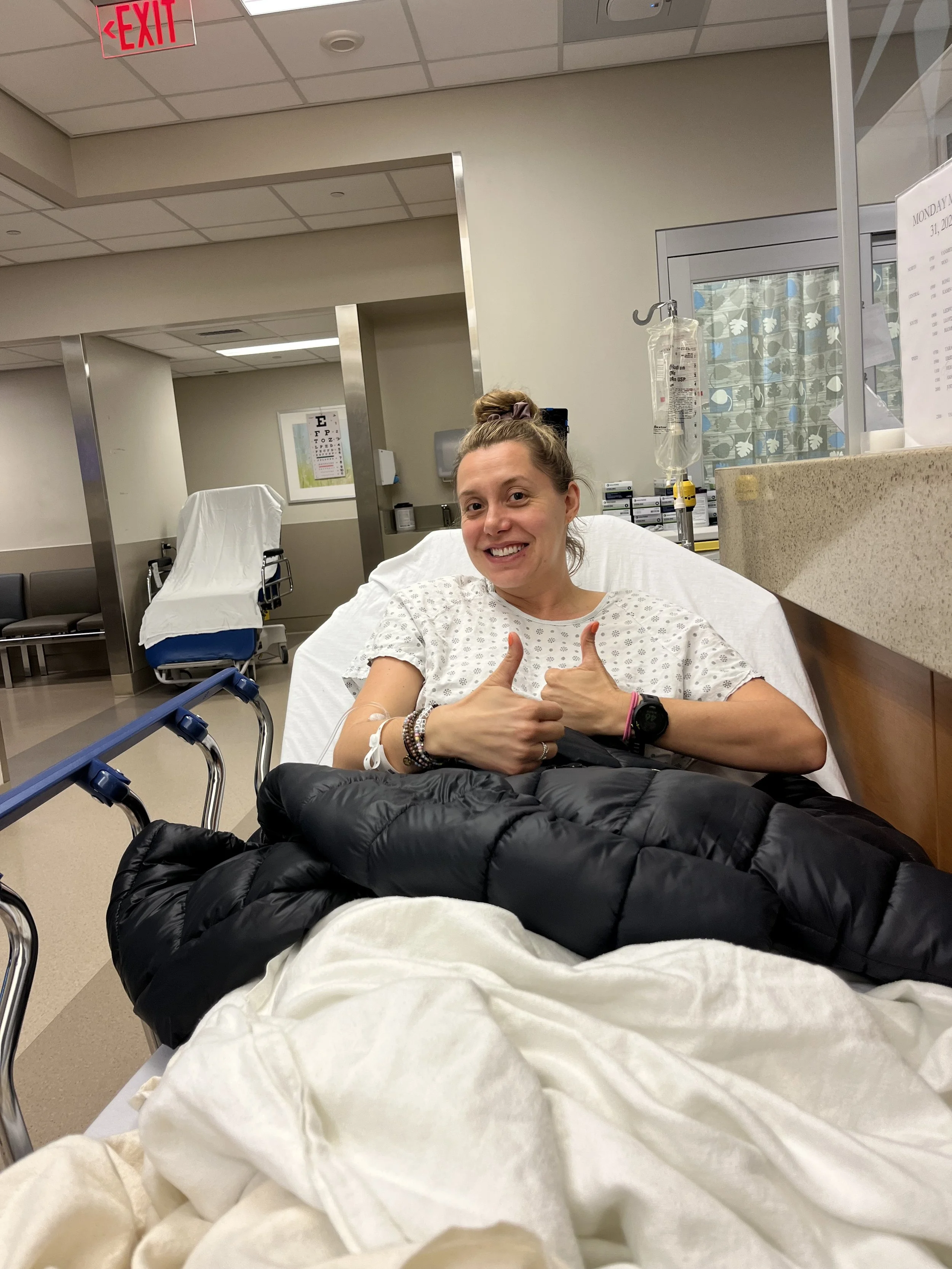
I found myself in a place I never expected to be that day: the emergency room.
I'm sharing this not to alarm you (I’m fully okay now!), but because the experience cracked something open in me—something too important not to pass along.
It brought me face-to-face with three forces we all encounter, in our bodies, relationships, and work:
Pain. Discomfort. Suffering.
And how often we confuse them—and prolong our own suffering because of it.
Pain, Discomfort, and Suffering:
Learning to Listen Before It’s Too Late
Earlier this month, I started my day like I often do: with a run.
The only difference was that I was running through the town where I grew up, visiting my parents for the weekend.
Halfway through the run, something felt... different.
As I paused at a light, I suddenly got dizzy and lightheaded. I decided to walk for a bit, then eased back into a light jog.
That’s when the stomach pain started.
At first, I brushed it off—assuming it was just some cramping—and kept going.
But the more I pushed through, the worse it got. Soon I felt like I might throw up.
I debated what to do.
Maybe I could just slow down? Walk-run for a bit?
I’d had uncomfortable moments on runs before and usually pushed through, feeling better after a few minutes.
But this time felt different.
Something in me knew I needed to stop.
I called my mom to pick me up.
Back at the house, the pain escalated to an unbearable level.
I had never felt anything like it before.
I’ll spare you the details, but after throwing up several times and nearly fainting, my mom made the call: urgent care.
From there, they quickly sent me to the emergency room.
At the ER, as the nurse checked me in and got my IV set up, she asked,
"Have you been under any new or extreme stress lately?"
I had to laugh. Internally, I thought—“I literally coach people on stress management... and yet, here I am.”
It was humbling. And so deeply human.
As I sat there, I started thinking about stress, pain, and the way we move through the world.
And this simple framework came to mind:
Pain | Discomfort | Suffering
A necessary signal that something needs care or change
The stretching sensation of growth
What happens when we ignore pain or stay stuck
Pain asks for attention.
Discomfort asks for curiosity and courage.
Suffering asks, "What are you avoiding?"
Our bodies are always communicating with us.
Pain isn’t just an idea—it’s a signal we feel physically, emotionally, and energetically.
The real question is: Are we willing to slow down enough to listen?
When we ignore those early whispers, the body doesn’t stop speaking—it just speaks louder.
The thing about pain is that our first instinct is often to move away from it.
We ignore it, push through it, numb it, or try to outrun it.
We think: If I can just get past this moment, everything will be fine.
But here's the counterintuitive truth:
It's by moving toward our pain—not away from it—that we find relief.
When we pause and sit with pain—whether physical, emotional, or something deeper—we can truly understand what it’s asking for:
Care. Attention. Change. Boundaries. Healing. Action.
Avoiding pain keeps us stuck in the stress cycle—fight, flight, freeze, fawn—a state we were never meant to live in long-term.
Staying there too long doesn't just prolong our suffering—it can cause serious harm over time.
It takes courage to face pain.
But when we do, we break the cycle.
We move toward healing. Toward freedom, ease, and deeper satisfaction.
Even as my body began stabilizing, part of me struggled to accept the help I needed.
The voice inside wanted to downplay everything—to believe I should have toughed it out alone.
But healing often starts with allowing others in.
I’m grateful my mom was there to remind me: this wasn’t something to endure alone.
We all need people who can reflect the truth back to us when we’re too overwhelmed to see it clearly.
Sitting there in the ER, I was reminded that stress management isn’t about eliminating stress completely. It's about learning how to partner with it wisely.
In my work, I often share four pillars that help build a sustainable relationship with stress:
✨Source Management — understanding and addressing the root causes of stress
✨Prevention — building systems that reduce unnecessary stress before it piles up
✨Thought Management — noticing and shifting the stories we tell ourselves
✨Relaxation and Regulation — giving our nervous systems a chance to reset
That day, every pillar came into play:
The source (my physical health) needed urgent care.
My thoughts needed compassion and reframing.
And once my body and mind were supported, my nervous system could finally regulate—and I could see my situation with clarity instead of panic.
Of course, this isn’t just about health emergencies.
Though it's often moments like these—emergencies, scares, wake-up calls—that force us to finally pause.
Pain, discomfort, and suffering show up in every part of life—often much more quietly.
Maybe you’ve felt it, too:
In a job that once energized you, but now leaves you exhausted or dreading Monday mornings.
In a relationship—romantic, platonic, or professional—where conversations used to feel expansive, but now feel like walking on eggshells.
In a life chapter where you keep telling yourself to "just push through," even though deep down you feel disconnected, burnt out, or like you're living a version of your life that no longer fits who you are becoming.
We convince ourselves it's "just a rough patch," or that "things will get better once [fill in the blank]."
But sometimes, the truth is that we're not just enduring—we're avoiding the pain that's asking for change. And that avoidance is what creates our suffering.
Underneath the avoidance, there’s usually fear:
Fear of the unknown.
Fear of uncertainty.
Fear of what we might be capable of if we actually listened.
There’s a difference between stretching and breaking.
Between discomfort that invites you forward—and pain that signals it’s time to let go.
Between endurance that builds resilience—and endurance that builds suffering.
It takes courage to pause, listen to the pain, and acknowledge the fear beneath it.
It takes even more courage to stay with it long enough to understand what it’s asking for.
That's where the real work begins.
Using tools like Source Management, Prevention, Thought Management, and Relaxation + Regulation, we can learn to release the pain and the stress instead of getting trapped inside it.
And on the other side?
More freedom. More ease.
And the kind of deep, steady satisfaction that doesn’t come from pushing through—but from choosing ourselves.
My visit to the ER was a powerful reminder—and it’s something I want to offer you, too:
You don’t have to wait until the whispers of your body, heart, or soul turn into screams.
Take a moment and check in with yourself:
Where are you feeling discomfort that’s inviting you to stretch and grow?
Where might you be enduring pain that's asking for your attention and care?
What support might you need—and are you willing to receive it?
You don’t have to carry it alone.
None of us can—or should.